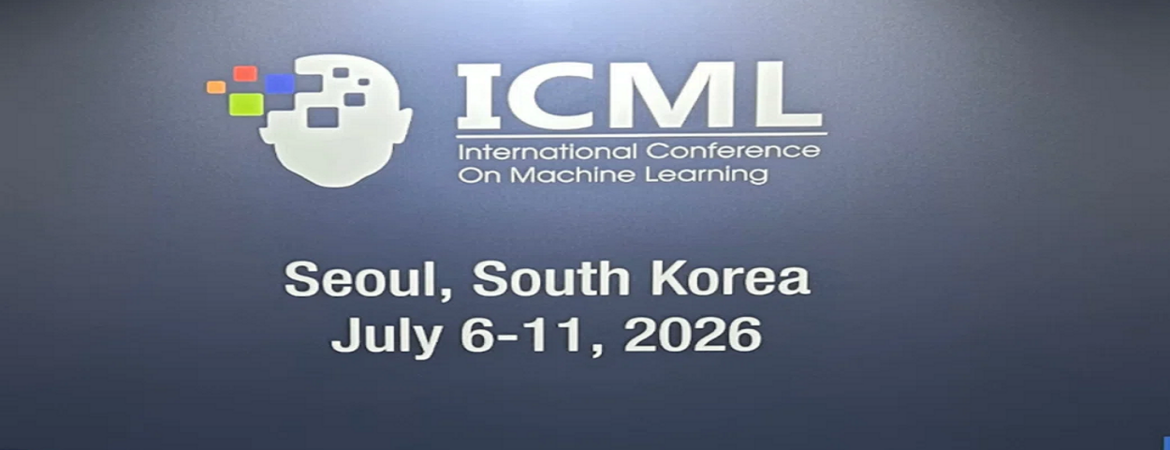
July 6, 2026. Five RAISE researchers, Nael Abu-Ghazaleh, Yuzhou Chen, Yue Dong, Greg Ver Steeg, and Yinglun Zhu, presented their research in the 43rd International Conference on Machine Learning (ICML) in Seoul, South Korea on July 6 to 11, 2026.
Nael Abu-Ghazaleh is Professor at the Computer Science & Engineering (CSE) Department. He presented "Modeling Hierarchical Thinking in Large Reasoning Models." International Conference on Machine Learning (ICML) with co-authors G. M. Shahariar (UC Riverside; UCR), Erfan Shayegani (UCR), and Ali Nazari (independent researcher). 2026. The abstract (https://icml.cc/virtual/2026/poster/64487) is as follows:
Large Reasoning Models (LRMs) solve complex tasks by generating long Chain-of-Thought (CoT) sequences; however, the emergent dynamics governing reasoning trajectories are not well understood and can lead to inconsistencies and reasoning pathologies. In this work, we propose to approximate LRM's emerging hierarchical reasoning dynamics as a trajectory within a Finite State Machine (FSM) transitioning among six abstract cognitive states. We demonstrate that these states and transitions can be captured in the latent state of the model. We believe that this representation can have different applications in the interpretability and optimization of LRM models. For example, by analyzing the topology of these transitions, we identify statistical shifts in reasoning strategies that help identify effective reasoning chains from those that fail. To illustrate these potential advantages, we propose Q-Value guided steering, a training-free inference-time control method that treats reasoning as a planning problem. We estimate the long-horizon utility of state transitions and apply sparse, orthogonal activation steering at sentence boundaries to align the CoT generation with optimal reasoning policies. Experiments across four benchmarks (AIME25, MATH-500, GSM8k, and GPQA Diamond) using three state-of-the-art open reasoning models demonstrate that Q-Value steering policy achieves significant performance gains with "surgical'' efficiency, often requiring 25X fewer interventions than greedy and weighted baselines, which suggests that reasoning can be effectively controlled by guiding high-level cognitive dynamics rather than micro-managing token generation.
Yuzhou Chen is Assistant Professor of Statistics. He presented “Large Language Models as Topological Thinkers: A Benchmark on Graph Persistent Homology” with co-authors Hao Li (Wuhan University; WU), Hao Wan (WU), Yixue Huang (WU), Yulia Gel (Virginia Tech), and Hao Jiang (WU). The abstract (https://icml.cc/virtual/2026/poster/63640) is as follows:
Large language models (LLMs) are increasingly used in scientific discovery, system modeling, and decision-making, prompting interest in their ability to reason over complex structured data. Existing benchmarks primarily focus on static or local graph reasoning, overlooking the high-order structures in real-world systems whose global properties evolve across multiple scales. We introduce LLM4PH, a benchmark that evaluates multi-scale structural reasoning through the lens of persistent homology (PH), a topological framework for tracking structural evolution. LLM4PH decomposes the PH pipeline into interpretable reasoning tasks spanning synthetic and real-world graphs, revealing that most models struggle with reasoning over structural transitions and persistence. Beyond task-level evaluation, we perform cross-task ablations on prompt encoding and transfer, explore post-training effects, and construct a compositional PH pipeline to assess end-to-end performance. Our results provide the first in-depth view of how well LLMs bridge discrete graph structures with continuous topological abstraction, and offer insights into their potential for structure-aware scientific reasoning.
Greg Ver Steeg is Associate Professor at the CSE Department. He presented “Is Your Diffusion Sampler Actually Correct? A Sampler-Centric Evaluation of Discrete Diffusion Language Models” with collaborators Luhan Tang (UCR), Longxuan Yu (UCR), and Shaorong Zhang (UCR). The abstract (https://arxiv.org/abs/2602.19619) is as follows:
Discrete diffusion language models (dLLMs) provide a fast and flexible alternative to autoregressive models (ARMs) via iterative denoising with parallel updates. However, their evaluation is challenging: existing metrics conflate denoiser approximation error with sampler-induced error from the sampling dynamics, a problem that does not arise for ARMs whose autoregressive sampling exactly reflects the learned probability model. We introduce a sampler-centric oracle framework that replaces learned denoisers with an exact Hidden Markov Model posterior derived from a ground-truth Markov chain, isolating sampler-induced error in a controlled setting. We show that few-step discrete diffusion samplers are not distributionally correct even under an oracle denoiser, with transition-level mismatch that vanishes only as the number of steps approaches the sequence length. Moreover, improvements in negative log-likelihood (NLL), generative perplexity (GenPPL), or MAUVE do not imply correct sampling. Code is available at https://luhantang.github.io/dllm_sampler.
Dr. Ver Steeg also presented “Local MAP Sampling for Diffusion Models” with Shaorong Zhang (UCR), Rob Brekelmans (Vector Institute). The abstract (https://arxiv.org/abs/2510.07343) is as follows:
Diffusion Posterior Sampling (DPS) provides a principled Bayesian approach to inverse problems by sampling from p(x0∣y). While posterior sampling is valuable for capturing uncertainty and multi-modality, many classical and practical inverse problem settings ultimately prioritize accurate point estimation -- most notably the MAP estimator, which has long served as a standard reconstruction objective in imaging and scientific applications. We introduce Local MAP Sampling (LMAPS), a new inference framework that iteratively solves local MAP subproblems along the diffusion trajectory. This perspective clarifies their connection to global MAP and DPS, offering a unified probabilistic interpretation for optimization-based methods. Building on this foundation, we develop practical algorithms with a covariance approximation motivated by a Gaussian prior assumption, and a reformulated objective for stability and interpretability. Across a broad set of image restoration and scientific tasks, LMAPS achieves state-of-the-art performance.
Yinglun Zhu is Assistant Professor at the Electrical & Computer Engineering Department. He presented “Active Learning with Foundation Model Priors: Efficient Learning under Class Imbalance” with Jiancheng Zhang (UCR), Meiqing Li (Carnegie Mellon University), and Qi Zhang (Worcester Polytechnic Institute). The abstract (https://icml.cc/virtual/2026/poster/60881) is as follows:
Real-world datasets across image and text domains are often characterized by skewed class distributions and noisy annotations, which jointly degrade model performance, particularly on minority classes. Among existing solutions, active learning offers an effective and efficient paradigm by selectively querying the most informative and balanced samples for annotation. We propose an innovative active learning framework that mitigates class imbalance and selects the most informative samples to annotate. Leveraging foundation model priors, our algorithm enables imbalance-aware co-decisions between foundation model and small model to tackle noisy and imbalanced labels across various domains. We introduce the first study to systematically explore active learning under the dual challenges of label noise and class imbalance across image and text domains. Extensive experiments on imbalanced datasets demonstrate that our method achieves substantial annotation savings—over 50\% compared to the best active learning baseline—while preserving performance and robustness to label noise.
Yuzhou Chen is Assistant Professor of Statistics. Yue Dong is Assistant Professor of at the CSE Department. She presented “Decoy for the Judge: Disrupting Multi-Turn Jailbreaks using Semantics-Preserving Output Rewriting” with collaborators from UC Berkeley and International Computer Science Institute (ICSCI) (Huanli Gong, Zhipeng Wei, and Ananya Gupta), UC Riverside (Yu Fu and Haz Shahgir), and ICSC and Lawrence Berkeley National Laboratory (Benjamin Erichson). The abstract (https://icml.cc/virtual/2026/poster/65706) is as follows:
Multi-turn jailbreak attacks pose a growing threat to large language model (LLM) safety because they exploit feedback from auxiliary judge models to iteratively refine prompts toward harmful goals. Existing defenses largely detect or block unsafe content at individual turns or at the final response, leaving the judge-driven refinement loop intact and allowing attackers to extract informative feedback from intermediate interactions. We introduce D-Judge, a semantics-preserving output rewriting defense that intervenes directly in this loop by rewriting the victim LLM’s responses before they are evaluated by the attacker’s judge. By misaligning the judge’s feedback signal without changing the meaning of the original response, D-Judge derails the attacker’s prompt-refinement process, causing subsequent queries to be optimized against a distorted signal of attack progress. To improve D-Judge’s ability to produce such rewrites, we construct a dataset of semantically equivalent response pairs that induce different judge-assigned harmfulness scores, and use it for supervised fine-tuning followed by direct preference optimization. Experiments on HarmBench show that D-Judge reduces the success rate of state-of-the-art multi-turn jailbreaks while preserving performance on benign benchmarks.
Let us help you with your search