Three pioneering studies by UC Riverside researchers will be presented orally in September at the 19th European Conference on Computer Vision (ECCV 2026) in Malmö, Sweden, one of the world's premier conferences on computer vision and artificial intelligence. Together, the studies advance machine perception—the science of helping computers interpret visual information—by enabling them to see more clearly, understand more of their surroundings, and make better decisions. Led by faculty members and students in UCR's Marlan and Rosemary Bourns College of Engineering, the work highlights the university's growing leadership in developing technologies that help computers better understand the visual world—from improving scientific imaging to making autonomous vehicles safer. Only 5% of the papers submitted to the conference were selected for oral presentations.
Here are the studies to be presented (UCR authors in bold):
Computational Mirrors: Broadband Wide Field of View Imaging with Computational Mirrors
Vishwanath Saragadam, Niki Nezakati, Amit Roy-Chowdhury, and Vivek Boominathan (Rice University)
Cameras that can detect both visible and infrared light could help scientists better monitor crops and forests, allow first responders to see through smoke and fog, and reveal details invisible to conventional cameras. But today's systems typically rely on large, heavy, and expensive lenses. UCR researchers developed Computational Mirrors, a new imaging technology that replaces much of that complex glass with lightweight mirrors and image-processing software. The system captures just a few images at different focus settings and combines them into a single sharp image across both visible and infrared wavelengths. The approach could lead to smaller, lighter, and less expensive cameras for environmental monitoring, remote sensing, scientific research, and defense, making advanced imaging practical in places where bulky optical systems are too costly or cumbersome.
Provable and Robust Wavefront Sensing via Self-Reference Interferometry
Nebiyou Yismaw, Vishwanath Saragadam, Aswin C. Sankaranarayanan (Carnegie Mellon University), and M. Salman Asif
From giant telescopes that explore distant galaxies to microscopes that reveal inner workings of living cells, many advanced imaging systems depend on understanding not just how bright light is, but also how light waves travel through space. Conventional cameras capture brightness but cannot directly measure this additional information, making it difficult to produce the sharpest possible images. UCR researchers developed a new technique that overcomes this limitation without requiring the delicate reference laser used by conventional systems. Instead, the method compares light with slightly shifted copies of itself to recover the missing information. The approach could make wavefront sensing—a technology used in astronomy, biomedical imaging and other advanced optical systems—more accurate, reliable and practical, enabling telescopes and other instruments to produce sharper images under real-world conditions. The paper was one of the 10 Best Paper Award nominees.
CooperScene: Multi-Modal Cooperative Autonomy Benchmark with C-V2X Communication Characterization
Bo Wu, Ruoshen Mo, Justin Yue, Yanyu Zhang, Janice Nguyen, Guoyuan Wu, Amit Roy-Chowdhury, Matthew J. Barth, and Hang Qiu
Self-driving cars can only react to what their own cameras and sensors can detect. That becomes a problem when another vehicle, a building or even a large truck blocks their view. UCR researchers created CooperScene, a new dataset that helps scientists develop vehicles that can safely share information with one another and with roadside equipment, giving them a better picture of what lies beyond their own line of sight. Unlike previous research datasets, CooperScene captures how these communications perform in real traffic, where wireless connections can slow down or lose data. The resource will help researchers design safer autonomous driving systems that can make better decisions under real-world conditions rather than ideal laboratory settings.
Each of these papers will be the subject of oral presentations at ECCV 2026, running Sept. 8-12, where researchers from academia and industry gather to showcase the latest advances in computer vision and artificial intelligence. Oral presentations are especially competitive, with fewer than 5% of submitted papers receiving that distinction.
"Having three oral presentations accepted to ECCV reflects the growing strength of UC Riverside's AI and computer vision research community," said Vassilis Tsotras, a distinguished computer science professor and co-director of the RAISE@UCR Institute. "Our faculty and students are tackling challenging scientific problems while developing technologies that have the potential to improve medicine, transportation, and many other fields."
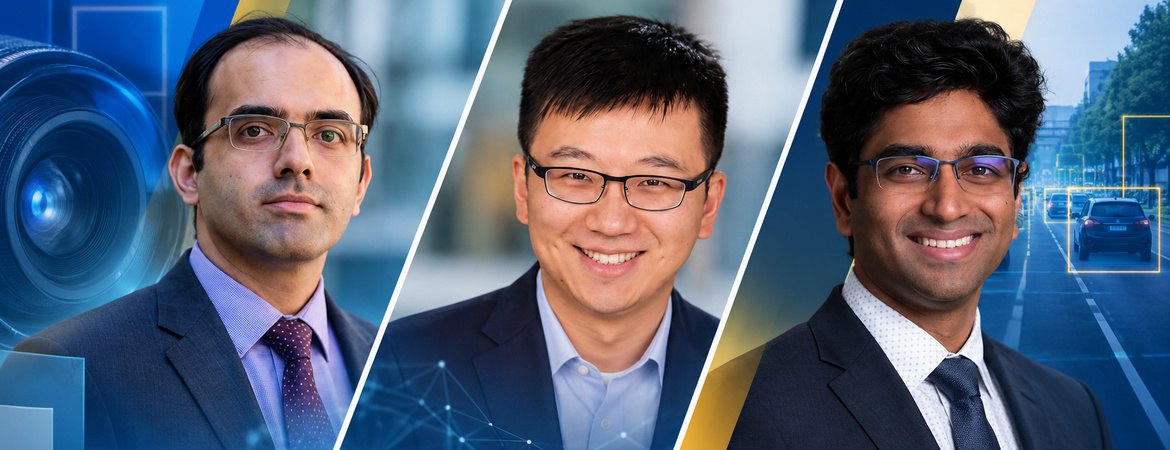
Header image: M. Salman Asif, Hang Qiu, and Vishwanath Saragadam
Let us help you with your search